

EXECUTIVE SUMMARY
Monastery Square
8902 Ridge Boulevard, Bay Ridge, Brooklyn
Block 6079, Lot 1
The Request
We respectfully ask the New York City Landmarks Preservation Commission to designate the entire Monastery Square—approximately 7.5-acre former Visitation Academy, Sacred Heart Chapel, and Monastery of the Sisters of the Visitation of Holy Mary property at 8902 Ridge Boulevard—as a single New York City Individual Landmark.
The request encompasses the historic monastery and Academy buildings, Sacred Heart Chapel and Alumnae Room, monumental enclosure wall and gates, Stations of the Cross and devotional features, historic lake and boathouse, courtyards, pathways, mature trees, lawns, hills, and open grounds, including the historic monastery burial ground.
The central argument is simple: The whole campus is the historic resource. Preserving only selected buildings would not protect the historic institution that generations of Brooklyn citizens knew, used, and sustained. For more than 120 years, its buildings and landscape functioned together as the home of a contemplative women's religious community, a school devoted to the education of girls, and a place of worship, gathering, and tradition for the wider Brooklyn community.
More Than 150 Years of History on One Property
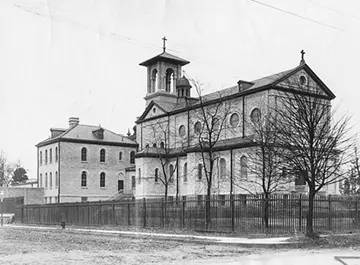
The Bay Ridge property's institutional history began decades before Visitation. The Inebriates’ Home for Kings County, incorporated in 1867, belonged to the first generation of specialized American institutions created around the emerging concept of alcoholism as a disease requiring treatment. It developed alongside pioneering institutions in Binghamton, Boston, and New York City, and contemporary specialists identified Kings County as treating inebriety according to medical principles. The Home treated men and women, court-committed patients, and voluntary private patients, with separate accommodations for different patient populations; private treatment could cost as much as $40 per week. In 1869, architect Ebenezer L. Roberts prepared plans for its monumental principal building, substantial portions of which survive as the later Visitation Monastery. The building, therefore, represents both Visitation history and an important earlier chapter in the development of alcoholism treatment in nineteenth-century New York.
A second major institutional building, bearing a surviving 1888 cornerstone, later became the Visitation Academy school building. When the Sisters acquired the property in 1903, they preserved and adapted these substantial nineteenth-century buildings rather than demolishing them.
The historic lake also predates Visitation. It was naturally formed by a stream descending the hill and collecting in the lower ground, and was later reinforced with stone and cement before the Sisters arrived. An 1898 atlas, five years before Visitation's arrival, depicts the irregular water body and labels it “POND.” It subsequently became an integral part of Academy life, remembered by generations of students for
boating, skating, and school traditions.
Visitation: A Brooklyn Institution Since 1855
Visitation Academy's history began 48 years before the move to Bay Ridge. The Brooklyn Visitation community and its school were founded in 1855. Before reaching Bay Ridge, the Sisters operated the Academy at three successive Brooklyn locations: Lawrence Street; Johnson and Pearl Streets; and Clinton and Willoughby Avenues. In 1903, they established their permanent monastery and Academy at 8902 Ridge Boulevard.
The Sisters called the property “Beautiful View.” Its hills, lake, mature trees, and open acreage provided the privacy required for contemplative religious life while allowing the Sisters to continue their educational mission. The 1917 Academy catalogue described a rigorous curriculum and stated Visitation's goal of forming “valiant women” who would become “a power for good everywhere.” That educational mission continued in Bay Ridge for 121 years, from 1903 until the Academy closed in June 2024.
Sacred Heart Chapel: A Landmark Within the Community
Sacred Heart Chapel, constructed between 1911 and 1913, was designed by Brooklyn architect Franz J. Berlenbach Jr. and built by Herman Veit. Its historic interior includes Carrara marble, stained glass, religious artwork, historic lighting, vaulted ceiling, and Reuben Midmer & Sons organ. The chapel even preserves material from the Sisters' previous Brooklyn home. When they moved from Clinton Avenue in 1903, the Sisters brought their historic sanctuary's stained-glass windows with them; these were subsequently incorporated into Sacred Heart Chapel. Significantly, the chapel's stained-glass windows are not confined to an interior religious space: they are visible from the surrounding public streets and form part of the chapel's architectural presence in the Bay Ridge streetscape. For generations, the beauty created for Visitation has also been part of the visual experience of the surrounding community.
Former students helped make the chapel possible. The Visitation Alumnae Association, organized in 1904, made fundraising for a new chapel one of its earliest objectives. Through years of fundraising, the alumnae raised $50,000 toward the construction of Sacred Heart Chapel, demonstrating the extraordinary commitment of former Visitation students to the institution. The chapel was therefore not simply constructed for the Visitation community; it was made possible in substantial part through the efforts and generosity of the women who had been educated there, creating a sacred and architectural landmark that would become part of the religious, cultural, and community life of all of Bay Ridge.
Sacred Heart Chapel was never simply a private chapel hidden behind monastery walls. Public access dates to its earliest history. In March 1913, The Tablet announced the Solemn Novena to the Sacred Heart in the newly completed chapel and expressly extended “an invitation ... to all.” The annual Sacred Heart Novena remained a public tradition for more than a century. Sunday Mass likewise welcomed members of the wider community. First Communions, Confirmations, funerals, memorials, and other religious observances brought generations of Brooklyn citizens onto the property. The chapel and monastery grounds were not used solely by the Sisters, students, alumnae, or Visitation families; they were also places of worship and gathering for the surrounding community.
Community life extended outside the chapel as well. During the Christmas season, the chapel and surrounding grounds became a gathering place through the outdoor Nativity, Christmas trees, Advent observances, and community singing, bringing students, families, alumnae, neighbors, and community groups together around Sacred Heart Chapel. Visitation was a cloistered religious community, but religious enclosure and public engagement coexisted here for generations.
The alumnae also helped finance another defining feature: the monumental enclosure wall constructed in 1922. A dedicated Monastery Wall Fund supported its construction through alumnae dances, theater parties, bazaars, and other benefits. The Monastery Wall Fund raised $40,000 to build the sixteen-foot-high concrete wall.
In 1923, the Stations of the Cross were installed directly along the interior face of that wall, transforming the wall itself into part of Visitation's devotional landscape. The enclosure wall, therefore, served not merely as the boundary of the property but as an integral part of the religious and historic environment of Monastery Square.
The chapel and wall also tell an important story of women's stewardship: women educated at Visitation helped build and preserve the institution for the girls and the community that followed them.
The Land Itself Matters
The approximately 7.5 acres within the wall are not excess land surrounding historic buildings. They are part of the history.
The lake, hills, mature trees, courtyards, pathways, lawns, and devotional spaces created the environment in which Visitation life occurred. The 1917 Academy catalogue specifically celebrated the property's wooded landscape and its maple, chestnut, cedar, birch, fir, and Norwegian pine. The grounds also contain a historic monastery burial ground preserved in Visitation's institutional memory. This history does not rest on a single rumor or recent recollection. Multiple independent accounts preserve statements originating with Sisters of the Visitation themselves, identifying a burial ground on the monastery property, while additional oral histories independently recall the cemetery and the restriction of student access to that portion of the grounds. Significantly, these accounts repeatedly associate the burial ground with the same general area of the enclosed monastic landscape.
These accounts carry particular historical weight because the knowledge originated with the Sisters of the Visitation, who occupied, controlled, and cared for this property for more than a century. The Sisters were not outside observers repeating a neighborhood legend; they were members of the community responsible for the monastery and its grounds. Their statements, therefore, constitute important firsthand institutional evidence of how this part of the property was understood and used.
The existence of the burial ground is further consistent with the documented practice of maintaining on-site burial grounds at other Visitation monasteries in the United States. The burial ground should be protected from ground disturbance and professionally investigated as part of any archaeological review of the property.
A Place That Formed Remarkable Women
Among the women educated at Visitation were two whose lives connect this Brooklyn school to major events of twentieth-century history.
Sister Madeline Maria Dorsey, Class of 1932, became a Maryknoll Sister, nurse, hospital administrator, civil-rights participant, and international missionary. Her work included integrated health care in the United States and decades of missionary service abroad. After a lifetime of service, she returned to Visitation in 1993 as its Distinguished Graduate, returning to the same Academy, chapel, Alumnae Room, and monastery that had helped form her.
Sister Ita Ford, Visitation Academy Class of 1953, became a Maryknoll Sister and missionary serving impoverished and displaced people in Latin America. On December 2, 1980, she was murdered in El Salvador with Maura Clarke, Dorothy Kazel, and Jean Donovan. Ford is remembered as a martyr, and her life powerfully fulfilled Visitation's 1917 ideal of creating “valiant women” who would become “a power for good everywhere.”
Before Sister Madeline Maria Dorsey carried her faith into hospitals, the Civil Rights Movement, and missions around the world, and before Sister Ita Ford became a Maryknoll missionary and martyr in El Salvador, they were both Visitation girls.
Mother Teresa at Visitation
In January 1986, Visitation received one of the most internationally recognized religious and humanitarian figures of the twentieth century: Mother Teresa of Calcutta, now Saint Teresa of Calcutta. Her personal visit came during the same period as her extraordinary humanitarian work in New York City. Only days earlier, Mother Teresa and the Missionaries of Charity had opened Gift of Love, a fourteen-bed residence in Greenwich Village providing care for people with AIDS at a time when those suffering from the disease faced profound fear, stigma, and discrimination.
During that same visit to New York, Mother Teresa went to Sing Sing Correctional Facility, where she met three prisoners suffering from AIDS. She sought their release so that they could receive compassionate care outside the prison. Her request ultimately reached Governor Mario Cuomo, who authorized medical furloughs for the three men on humanitarian and compassionate grounds. Amid this work, on January 3, 1986, Mother Teresa came to the Visitation Monastery in Bay Ridge for a personal visit. This visit was not a previously announced part of her public tour. She met with the Sisters in the monastery library and, as she departed, encountered teachers, students, parents, and others who had remained on the grounds hoping to see her. She distributed Miraculous Medals to those who had gathered.
The visit is preserved not only through oral history but through surviving photographs and physical evidence. The Visitation Sisters preserved the chair associated with her visit in the monastery library, bearing a plaque commemorating the occasion: “Mother Teresa was here January 3, 1986.” Her presence connects the Visitation Sisters of Brooklyn to the life of one of the most recognized religious and humanitarian figures of the twentieth century and to a remarkable moment in New York City's history.
Why the Entire Property Must Be Preserved
Visitation's significance is cumulative. The property still contains an extraordinary physical record of its history: a nineteenth-century institutional building planned in 1869 and later used as the monastery; the Academy building with its 1888 cornerstone; a naturally formed historic lake existing before the Sisters arrived; stained glass brought from Clinton Avenue in 1903; Sacred Heart Chapel completed in 1913; the monumental enclosure wall built in 1922; the Stations of the Cross installed along the interior face of that wall in 1923; the historic monastery burial ground; and the courtyards, pathways, trees, hills, and open spaces used by generations of Sisters, students, and Brooklyn citizens.
Saving only the chapel would separate it from the monastery, school, and landscape that explain why it exists. Saving individual buildings while destroying the lake, grounds, wall, devotional landscape, or archaeological resources would preserve pieces of Visitation while losing the historic place itself. For 121 years in Bay Ridge—and through an educational history beginning in Brooklyn in 1855—these buildings and grounds functioned together as one institution. They should be evaluated and preserved in the same way.
Our Request to New York City
We respectfully ask elected officials and community leaders to support the request that the New York City Landmarks Preservation Commission evaluate and designate the entirety of 8902 Ridge Boulevard, Block 6079, Lot 1, as a single Individual Landmark.
Our home. Our history. For all time.
Submitted by the Visitation Academy & Monastery Landmark Initiative
TOGETHER, WE CAN PRESERVE
VISITATION’S LEGACY.

The two primary buildings on the Inebriates' Home became the Monastery and Academy in 1903.


This area would become the playground

Saint Teresa of Calcutta made a personal visit to the Visitation Monastery during her public visit to New York City. Read more about this historic day in our Executive Summary.


Visitation students, families and community members participate in the May Crowning.
Help Us Secure VISITATION'S LANDMARK Status.
Please sign up now!
Let us know you stand with us
Every name matters.
TOGETHER, we will LANDMARK VISITATION